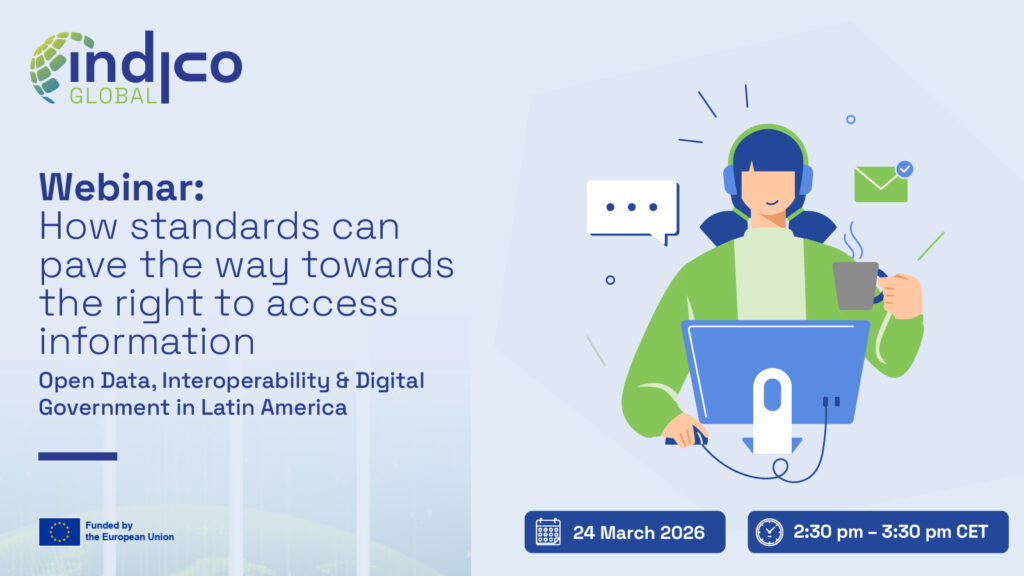
On 24 March 2026, InDiCo-Global hosted a webinar exploring how European standards are being translated into practice in partner regions. The session — “How standards can pave the way towards the right to access information” — brought together practitioners from Mexico and Guatemala, alongside European standards experts, to examine the realities of implementing EU-aligned open data and interoperability frameworks in Latin American public administrations.
The challenge: open data without standards leads to fragmentation
Xavier Piednoir, InDiCo-Global Project Coordinator at ETSI, opened the session by framing the central challenge: while the intent to make data publicly available is important, it is not sufficient on its own. Without common formats, documented interfaces, and interoperability standards, open data policies risk producing fragmented, inaccessible, or unusable outputs. Standards, he argued, are the technical foundation that transforms open data policy into a practical reality for citizens, businesses, and public administrations alike.
Guatemala: standards as tools for transformation
Julio Herrera Toledo, Executive Director of Red Ciudadana, presented results from the organisation’s seven-month InDiCo-Global Open Call project, which focused on advancing digital government in Guatemala through European standards. Working across interoperability, open data, data protection, and accessibility, the project drew on EU frameworks including the European Interoperability Framework, GDPR, and EU open data and accessibility standards — adapting them to Guatemala’s legal, institutional, and cultural context.
Key results included training over 950 public officials, supporting five institutions in interoperability implementation, conducting three real-world pilots, and engaging directly with members of Congress on legislative proposals on cybersecurity, data protection and interoperability. The project also produced an interoperability framework structured around four layers — legal, organisational, semantic, and technical — reflecting the full complexity of what genuine interoperability requires.
Five lessons and challenges emerged from the process: adapting European standards to the local context is essential, and still many questions around how to translate them accordingly; awareness and skills across sectors is essential for capacity-building, from public institutions, civil society, and academia; strong institutional governance is essential; inclusion of civil society to bring inclussion of historical excluded groups; and standards work needs a strong governance to sustain the effors of open practices.
Julio concluded with a framing that resonated throughout the discussion: “Standards are not just documents — they are tools for transformation. Combined with capacity, governance, and implementation, they can change how the government serves citizens.”
Mexico: reconfiguring for impact in a changing landscape
The Mexico project, led by Ethos Innovación en Políticas Públicas, faced an unusual challenge early in its implementation: INAI, the National Institute of Transparency for Access to Information — the project’s original target institution — was dissolved at the outset of the project. The team adapted, redirecting their efforts toward the new Agency for Digital Trust, Transformation and Telecommunication, which coordinates an open data platform connecting 308 federal agencies.
The core activity became a three-day workshop bringing together public officials, civil society organisations, including Article 19, and academia to address how EU open data standards could be embedded into the new platform. The workshop produced a manual delivered to 32 Mexican entities and federal institutions, convened 356 public officials alongside 233 participants from academia, civil society, and the private sector, and ultimately contributed to the establishment of a National Open Data Observatory — a consolidated network to sustain and advance open data implementation across federal public agencies.
Panel discussion: the layers of interoperability and the road ahead
The moderated panel discussion, chaired by Sebastian Steinbuss of CEN/CENELEC JTC 25, explored the broader implications of the two projects. The discussion highlighted that interoperability operates across four distinct layers — technical, semantic, organisational, and legal — and that achieving it in practice requires alignment across all four, not just technical solutions alone.
Panellists noted the importance of political will in sustaining open data commitments over time. Julio drew on Guatemala’s experience of publishing an open data policy in 2018, only to find that few institutions were actually publishing data — prompting civil society to develop an Open Data Index to monitor and maintain accountability. The discussion also touched on the emerging challenge of AI agents as intermediaries between citizens and public data, and the need for policy safeguards to ensure data access remains genuinely open.
John Ketchell, representing ANEC on CEN/TC 465 on Smart Cities, highlighted the importance of civil society participation in standards development — noting that European standardisation’s formal inclusion of civil society voices through Annex III organisations is a structural strength that is not replicated in many other parts of the world. He also underlined a point echoed across the session: writing a good standard is not enough — its value depends entirely on whether it is applied.
Looking ahead
Closing the session, Xavier Piednoir noted that the two projects represent exactly the kind of bridge-building that InDiCo-Global was designed to support: sharing European approaches while learning from local implementation experience in ways that can inform practice both in partner regions and in Europe. He also flagged the GIST project in Colombia as a potential pathway for extending the work done in Guatemala to neighbouring countries in the region.
Missed the webinar? Watch the recording here.
 EN
EN  ZH
ZH  ZH_HK
ZH_HK