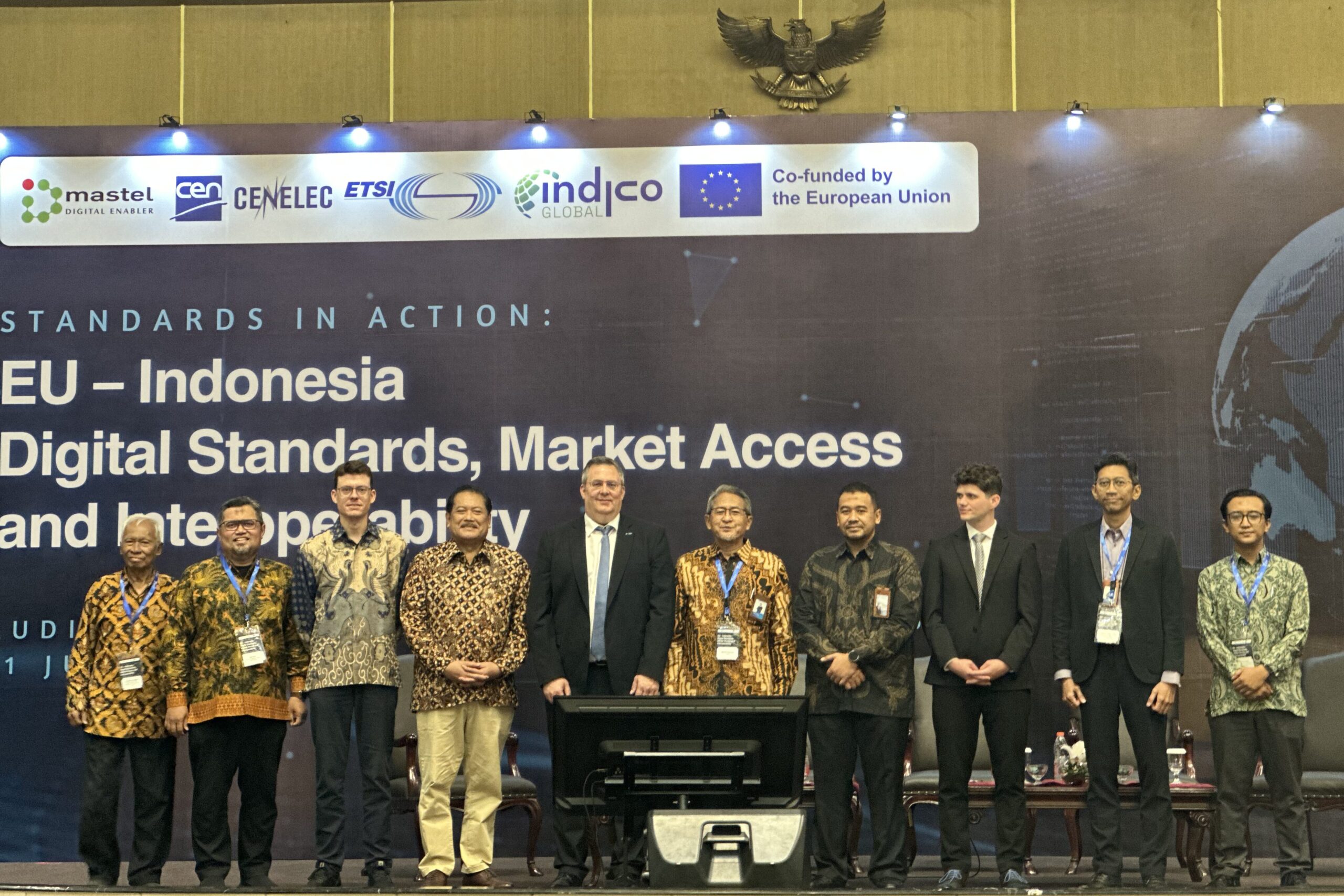
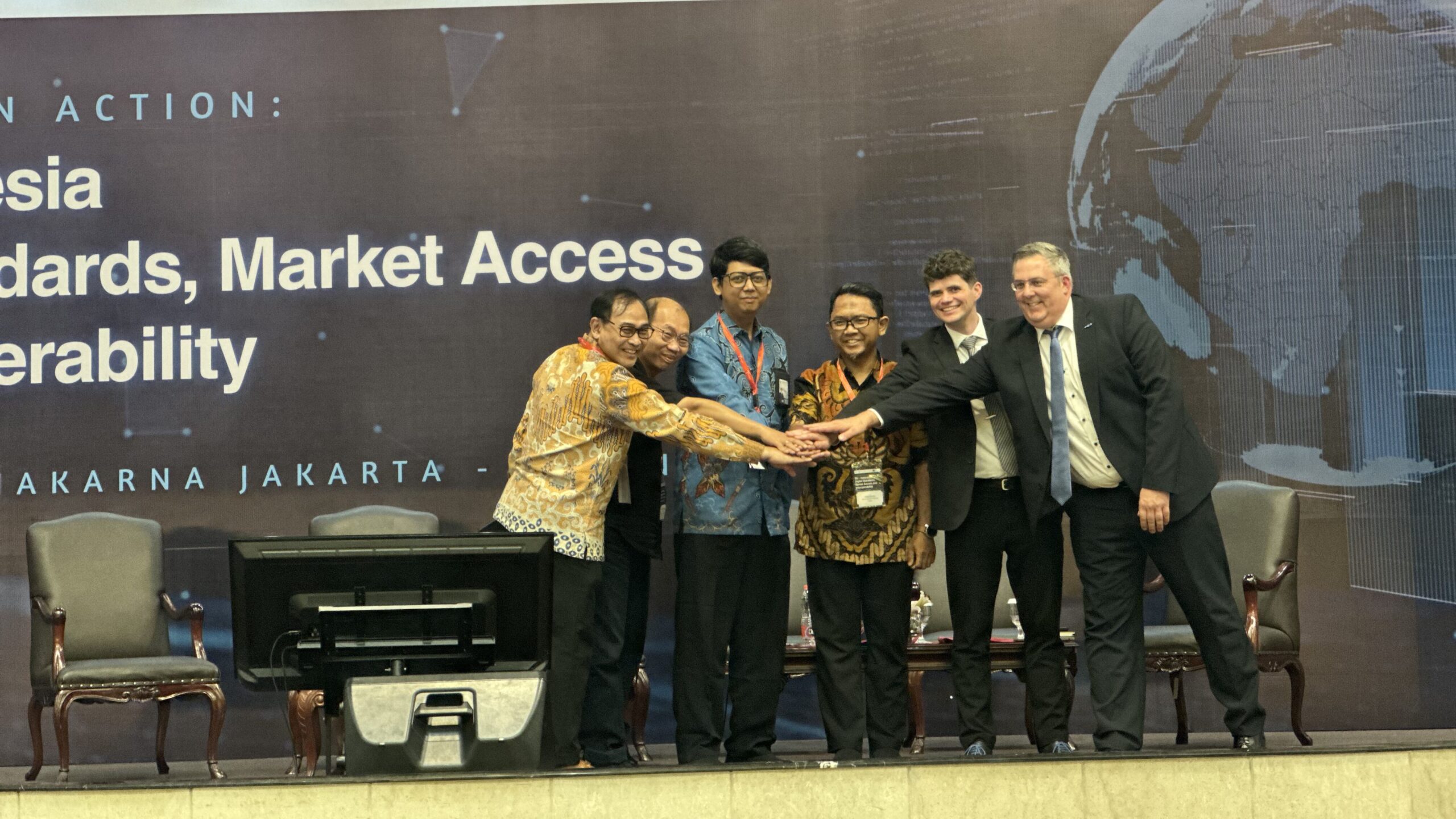
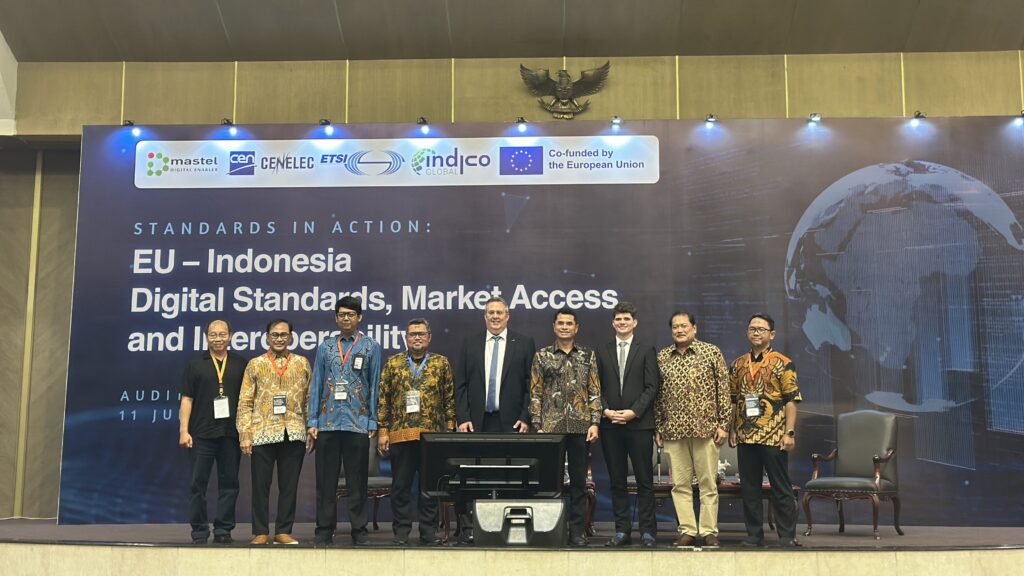
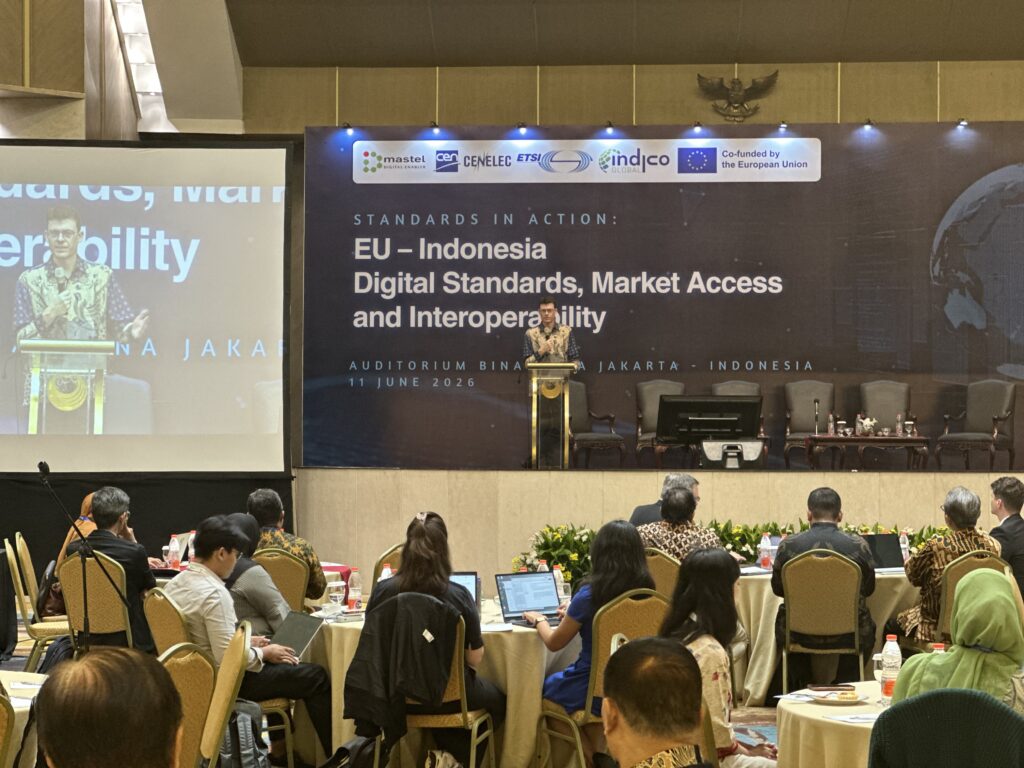
On 11 June 2026, more than 100 participants gathered in Jakarta for a high-level workshop co-hosted by MASTEL and the InDiCo-Global project, represented by consortium partners CEN, CENELEC and ETSI. Organised in partnership with Indonesia’s leading digital regulatory authorities — BSN, KAN, KOMDIGI, BSSN and BRIN — the day-long forum brought together regulators, standardisation bodies, and industry leaders to strengthen dialogue between European and Indonesian digital ecosystems.
Held under the title “Standards in Action: EU–Indonesia Digital Standards, Market Access and Interoperability,” the workshop set out to present the European and Indonesian standardisation frameworks side by side, explore their relevance to market access and regulatory alignment, and identify ways to bridge gaps between the two systems. Discussions spanned several priority digital domains, including cybersecurity, artificial intelligence, data governance, data centers, IoT, and 5G/6G technologies.
In his opening remarks, MASTEL Chairman Sarwoto Atmosutarno described standards as “the invisible architecture of the global digital economy,” noting that Indonesia’s ability to set, adopt and harmonise digital standards is closely tied to its digital sovereignty, competitiveness, and standing as an equal partner in the global digital ecosystem.
Speaking on behalf of the European Union, Sander Happaerts, Green and Digital Counsellor at the Delegation of the European Union to Indonesia, underlined the EU’s ambition to remain a trusted digital partner for Indonesia, pointing to shared interests across artificial intelligence, digital identity, digital public infrastructure, cybersecurity, quantum computing and data governance. He stressed the EU’s commitment to a digital transformation that is “human-centric, trustworthy, and respects human rights and fundamental freedoms.”
In an institutional keynote, Adis Alifiawan, Director for Radio Frequency Spectrum Management, Satellite Orbit Affairs, and Digital Infrastructure Standardisation at KOMDIGI, framed standardisation as a strategic foundation for Indonesia’s digital infrastructure, calling for closer synergy between government, industry, academia, standardisation bodies and international partners to harmonise technical standards and expand global market access for Indonesian digital products and services.
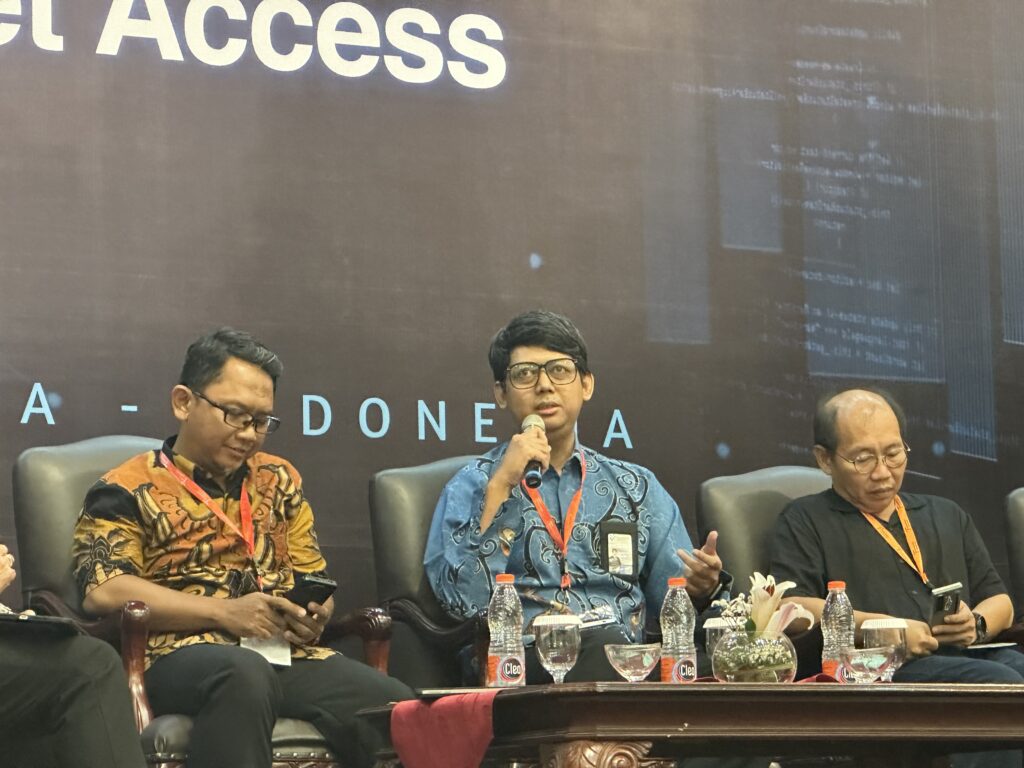
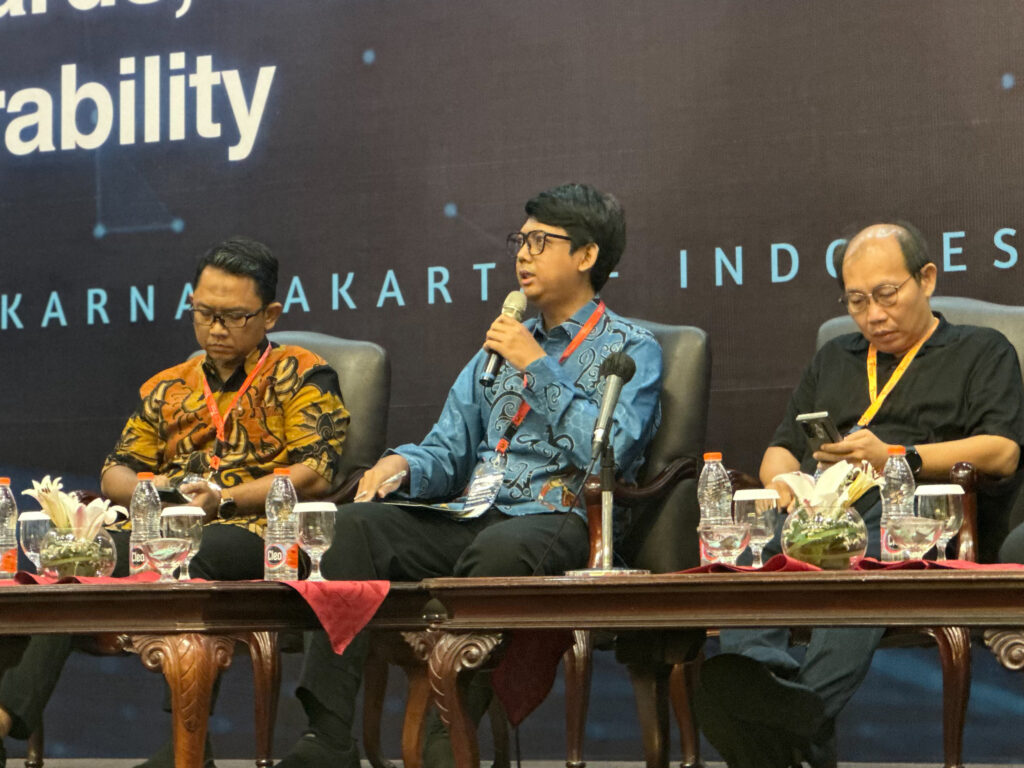
The programme’s panel discussions brought together a wide range of voices from both ecosystems. Hendro Kusumo, Deputy Head of BSN for Standards Development, set out Indonesia’s progress in building its National Quality Infrastructure — including its 23rd-place ranking in the 2025 Global Quality Infrastructure Index and a body of more than 10,000 active Indonesian National Standards (SNI) — while noting that implementation levels remain low and that BSN and KAN are working with European partners to advance digital and ICT accreditation schemes in areas such as cybersecurity, data infrastructure, forensic investigation and laboratory quality assurance.
A recurring theme across the sessions was the need to translate dialogue into concrete, technical cooperation. Sigit Jarot, ICT Standardisation Expert with the Global Partnership for Human-Centric ICT Standardization (GIST) project and Head of MASTEL’s National Telematics Infrastructure Division, observed that while Indonesia has built credibility on the international stage, its engagement has so far been largely administrative; elevating this to genuine technical and contributory participation — particularly in AI, 5G/6G and data centres — was identified as a priority for realising the country’s digital sovereignty ambitions.
Teguh Prasetya, representing MASTEL’s Industry and Independence IoT, AI, and Big Data working group (TRIOTA), pointed to interoperability and user needs as the common thread running through the day’s discussions, stressing that standards ultimately have to deliver greater security and convenience for the people using them.
Closing the session on cooperation priorities, Xavier Piednoir, coordinator of the InDiCo-Global project and ETSI Director of International Projects and Policy Affairs, described cooperation as key to addressing shared digital transformation challenges, and reiterated that citizens’ interests must remain central to any standards development. He noted that the workshop had succeeded in identifying standardisation gaps and agreeing actionable opportunities for follow-up, adding that the the GIST Project will follow-up on this event to facilitate the exchange of information and technical expertise between European standards bodies and Indonesia’s counterparts, so that digital standards serve as catalysts for sustainable trade and innovation between the EU and Indonesia.
The Jakarta workshop is the latest in the InDiCo-Global ESS Workshop series, following similar exchanges with CROSQ in Saint Vincent and the Grenadines and AFSEC in Cairo. By convening regulators, technical experts and industry across both ecosystems, the event reinforced the project’s ongoing role in supporting structured digital standards cooperation between Europe and its global partners.
 EN
EN  ES
ES  FR
FR