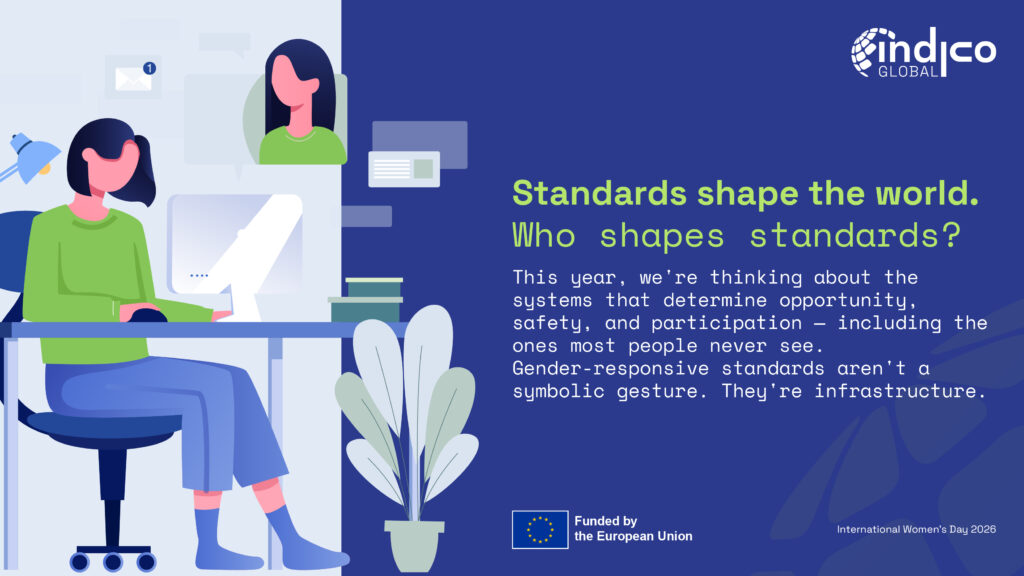
International Women’s Day is a moment to recognise progress toward gender equality, but also to reflect on the systems that continue to shape opportunity, safety, and participation worldwide. Among the least visible of these systems are standards: the shared rules that enable trade, technology, public services, and everyday products. Far from being purely technical, standards function as essential infrastructure for economic development, trust, and innovation across societies (World Development Report 2025).
Many technical specifications have historically been designed in male-dominated contexts and based on male bodies, experiences, and working conditions. As a result, equipment, workplaces, and even safety measures may not adequately reflect women’s needs, sometimes creating health and safety risks (HesaMag 31, When ‘neutral’ standards put women at risk).
Addressing these gaps requires gender-responsive standards: approaches that integrate gender perspectives, promote balanced participation in standards development, include gender inclusive language, and use appropriate data to ensure outcomes benefit everyone. These efforts contribute directly to achieving Sustainable Development Goal 5 on gender equality while strengthening inclusive and sustainable growth (UN Declaration on Gender-Responsive Standards and Standards Development).
A gender-responsive approach recognises that standards can have different impacts depending on gender and therefore requires explicit consideration of physical differences, social roles, and user experiences to ensure fair outcomes for all. Importantly, gender-responsiveness is not automatic. A balanced composition of experts does not by itself guarantee inclusive results. It requires awareness, expertise, appropriate methodologies, and the use of representative data (CEN and CENELEC).
The objective should therefore not only be improving technical content; it is equally about strengthening the capacity of institutions and experts to apply these approaches effectively. Women, young people, and stakeholders from low- and middle-income countries, remain under-represented in international standards development. Limited participation reduces the diversity of expertise developing standards and constrains the ability of countries and communities to benefit from standards-driven innovation, trade, and governance. In the worst cases, underrepresentation or biases may even cause harm.
This is where international cooperation and capacity building become decisive. Effective engagement in global standardisation depends on strong national standards bodies, skilled experts, and well-functioning quality infrastructure, capacities that are often still developing in parts of low- and middle-income countries. Strengthening these foundations enables broader participation in international rule-setting and helps ensure that standards support equitable economic opportunities, safer working conditions, and inclusive technological progress.
InDiCo-Global, including the three European Standards Organisations – CEN, CENELEC and ETSI – highlights the importance of embedding gender equality within this broader effort. By supporting capacity building in partner regions, the project works with national standards bodies, local researchers, and innovation communities to expand knowledge, foster inclusive participation, and strengthen connections to international standardisation processes. Empowering diverse experts to contribute to standards development is essential to ensuring global standards reflect real societal needs and enable sustainable development pathways.
Inclusive participation in standardisation is particularly critical as the world navigates digital transformation, climate action, and evolving global value chains. Standards in these areas will shape future economies and societies; ensuring that women and under-represented groups help design them is therefore both a matter of equality and a prerequisite for resilient, widely shared progress.
Advancing equality through technical standards is not a symbolic gesture. It is a practical pathway toward safer workplaces, stronger economies, and more inclusive innovation systems. Through cooperation, knowledge exchange, and capacity building, InDiCo-Global contributes to a future in which international standards are shaped by – and work for – everyone.
The message is clear: inclusive standards are a foundation for inclusive development and a common objective for the EU and its partners globally.
 EN
EN  ZH
ZH  ZH_HK
ZH_HK